Skip the bumpy roads or savour the scenic countryside? We compare the comfort, speed, wildlife opportunity, and overall value of flying versus driving between Tanzania’s parks — so you can choose with confidence.
At Kilisa Tours and Safari, we have designed and operated hundreds of safaris using both methods. In fact, many of our best itineraries combine elements of both — flying where speed and efficiency matter most, driving where the journey itself is part of the experience. This guide lays out everything you need to know, honestly and clearly, so you can make the right choice for your specific trip.
Understanding the Two Options
Before comparing them directly, it is worth being clear about what each option actually means in the context of a northern Tanzania safari.
What Is a Drive-In Safari?
A drive-in safari — sometimes called an overland safari — means all travel between destinations is done by road in your private safari vehicle. For most northern Tanzania itineraries, this means driving between Arusha and parks such as Tarangire, Ngorongoro, and the Serengeti — distances of between two and six hours depending on the route and road conditions.
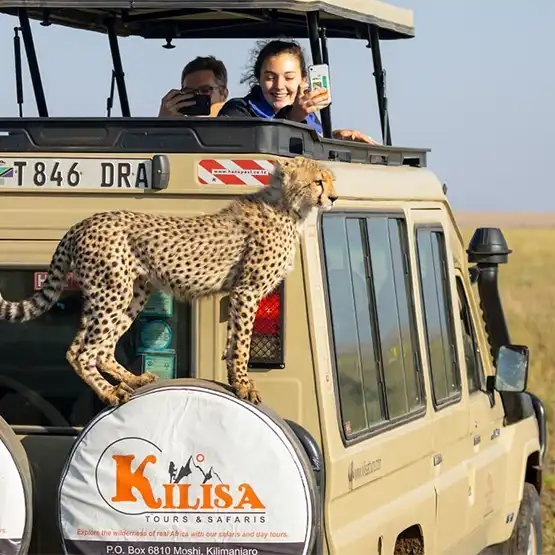
Crucially, the drive between parks is not dead time. The roads pass through Maasai landscapes, local villages, and scenery that tells the story of Tanzania in its own right. Moreover, wildlife sightings during transit drives are not uncommon — giraffes along the roadside, elephants crossing the road near Tarangire, or a cheetah on a termite mound visible from the highway. Your guide is always watching, and consequently, the transit drive is part of the safari experience from the moment you leave Arusha.
What Is a Fly-In Safari?
A fly-in safari uses small light aircraft — typically six to twelve-seat Cessna or similar planes — to transfer guests between parks via Tanzania’s network of bush airstrips. Rather than spending four hours on the road between, for example, the Ngorongoro Crater and the central Serengeti, you board a small plane at the Manyara airstrip and land at a Serengeti airstrip forty-five minutes later.
Furthermore, the flights themselves offer a completely different perspective on the landscape. Flying low over the Serengeti plains, the Rift Valley escarpment, or the crater rim of Ngorongoro provides an aerial view of Tanzania that no road journey can replicate. Many guests find the flights to be some of the most memorable moments of their entire trip.
Drive-In Safari: The Full Picture
The Advantages of Driving Between Parks
The Journey IS the Safari
On a drive-in safari, your guide is working from the moment you leave camp. Between parks, the landscape outside the window changes constantly — from highland forest to open savannah to the dust-red plains of the Maasai steppe. Additionally, transit drives through areas like the Karatu highlands or the edge of the Ngorongoro Conservation Area are frequently productive for wildlife sightings that most fly-in guests never experience. You are always in the safari, never waiting for it to begin again at the next airstrip.
Flexibility and Spontaneity
Driving gives your guide the freedom to stop anywhere, for any reason, at any time. A leopard in a tree beside the road, an unusual bird, a herd of cattle being driven by a Maasai warrior at dawn — none of these require advance scheduling. By contrast, a flight has a fixed departure time, and consequently, you cannot linger at a morning sighting if it means missing your plane.
Cost Efficiency
Drive-in safaris are generally less expensive than fly-in equivalents, as there are no internal flight costs to factor in. For guests travelling on a tighter budget or those who simply prefer to invest their money in accommodation and activities rather than transportation, driving is therefore a sensible and rewarding choice. Our budget camping safaris and mid-range safaris are all designed around private overland travel.
Deeper Cultural Immersion
Driving through Tanzania’s countryside puts you in direct contact with the country’s human landscape in a way that flying never can. Local markets, roadside villages, Maasai bomas, and the rhythm of daily life are all visible from the road. For travellers interested in cultural context — and we offer excellent cultural safari packages including 2-day, 3-day, and 4-day tours — the overland journey adds a layer of richness that no airstrip can provide.
The Limitations of Driving
Time on the Road
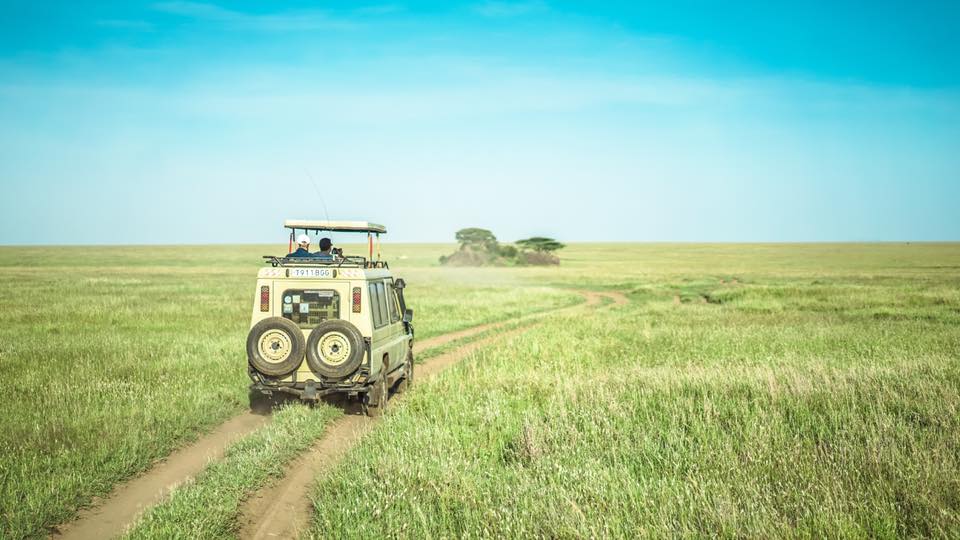
The primary disadvantage of drive-in safaris is simply the time spent driving between destinations. The road from Arusha to the central Serengeti, for example, takes approximately five to six hours under good conditions — and road quality varies significantly. While the journey is genuinely interesting, it does mean less time in the game-viewing areas of the parks themselves. For guests with limited time — four or five days, for instance — flying is therefore often the more efficient choice.
Physical Comfort
Tanzania’s park roads, while improving steadily, can be rough and corrugated in places. Long stretches of washboard track between parks are tiring, particularly later in a trip when energy levels are lower. For older travellers, those with back or joint issues, or anyone for whom physical comfort is a high priority, the drive-in option requires honest consideration.
Limited Access to Remote Destinations
Some of Tanzania’s most spectacular destinations are genuinely inaccessible by road within a reasonable safari timeframe. Parks such as Mahale Mountains, Katavi, and Rubondo Island can only be reached practically by air or boat. For guests who want to venture beyond the northern circuit, flying is therefore not a luxury — it is a necessity.
Fly-In Safari: The Full Picture
The Advantages of Flying Between Parks
Maximum Time in the Bush
The most compelling advantage of a fly-in safari is straightforward: you spend less time travelling and more time game viewing. A forty-five minute flight replaces a five-hour drive. As a result, you arrive at each camp fresh, with energy for an afternoon game drive rather than recovering from the road. Over a five or seven-day itinerary, this difference in available game-viewing time is substantial.
Access to Remote Locations
Flying opens Tanzania’s most remote and extraordinary destinations to guests who would otherwise never have time to reach them. In addition to the northern circuit parks, a fly-in itinerary can include Ruaha National Park, Selous Game Reserve, Mahale Mountains, and Katavi — parks that offer entirely different ecosystems, far fewer visitors, and wildlife experiences that complement the northern circuit beautifully.
The Aerial Experience
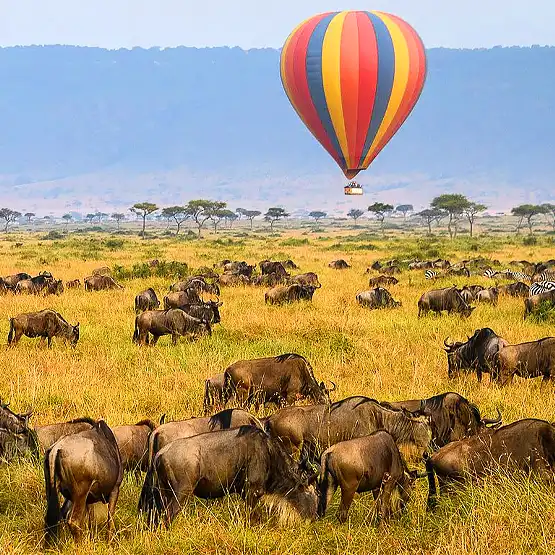
Flying low over the Serengeti at dawn, watching the Migration herds spread across the plains below, or seeing the Ngorongoro Crater from the air for the first time are experiences in their own right — not simply transport. Many guests tell us the flights were among the highlights of their entire safari. Furthermore, the aerial view provides immediate orientation to the scale of these landscapes in a way that no map or photograph can convey.
Physical Ease and Energy Preservation
A fly-in itinerary is physically easier. You arrive at each camp refreshed rather than road-weary, which means more enthusiasm and alertness for game drives — particularly important on afternoon drives that can extend well into the evening. For guests who find long vehicle journeys tiring, or those combining a safari with a physically demanding activity like Kilimanjaro, flying between parks makes excellent sense.
Efficiency for Short Trips
For guests with four or five days for their safari, flying is often the only way to experience multiple parks meaningfully. Without internal flights, a four-day itinerary covering Tarangire, Ngorongoro, and the Serengeti would sacrifice significant game-viewing time to road transfers. With flights, each destination gets the time it deserves.
The Limitations of Flying
Cost
Internal light aircraft flights in Tanzania represent a significant additional cost per person per sector. For guests travelling as a couple or family, this cost multiplies accordingly. However, when weighed against the additional game-viewing time gained and the physical ease it provides, many guests find the investment worthwhile. Our team is always transparent about flight costs when building itineraries, so you can make an informed decision.
Fixed Departure Times
Unlike road travel, flights operate on fixed schedules. If a spectacular sighting is happening at 10:00 AM and your flight departs at 10:30 AM, you face a choice. Moreover, flights can be delayed or rerouted by weather — particularly during the rainy seasons — adding a layer of scheduling uncertainty that road travel does not carry.
Luggage Restrictions
Light aircraft have strict weight and size limitations for luggage — typically 15 kilograms in a soft-sided bag per person. This is not a hardship if you pack sensibly, but it does require planning. Fortunately, luxury camps typically handle laundry, so travelling light is easy. Our packing guide and complete safari checklist are written with exactly these constraints in mind.
Less Cultural Connection
When you fly between parks, you bypass the human landscape of Tanzania entirely — the villages, markets, roadside scenes, and Maasai encounters that overland travellers experience naturally. For some guests this is not a concern; for others it represents a meaningful gap in the overall experience of the country.
Side-by-Side Comparison: Fly-In vs. Drive-In
| Factor | Drive-In Safari | Fly-In Safari |
|---|---|---|
| Journey experience | Scenic, wildlife-rich transit drives | Spectacular aerial views of the landscape |
| Game-viewing time | Reduced by road travel hours | Maximised — more time in the parks |
| Flexibility | High — stop anywhere, any time | Lower — fixed departure schedules |
| Physical comfort | Variable — roads can be rough | High — arrive fresh at each destination |
| Cost | Lower | Higher (internal flight costs per sector) |
| Cultural exposure | Rich — you see the human landscape | Limited — bypass local communities |
| Remote park access | Limited by road distances and time | Excellent — Ruaha, Selous, Mahale, Katavi accessible |
| Luggage | Generous — no strict weight limits | Restricted — 15kg soft bag only |
| Best for | Longer trips, cultural interest, budget-conscious travellers | Short trips, remote parks, physical ease, maximum wildlife time |
| Weather dependency | Low — roads operate in most conditions | Moderate — flights can be delayed by weather |
The Best of Both: Combining Road and Air Travel
Here is what years of building safari itineraries have taught us: for most luxury guests, the optimal solution is neither purely fly-in nor purely drive-in. Rather, it is a thoughtfully designed combination of both — flying where efficiency and access matter most, driving where the journey itself rewards.
For instance, a typical seven-day luxury northern circuit itinerary might look like this: drive from Arusha to Tarangire (two and a half hours — genuinely scenic and often productive for wildlife), spend two nights, then fly from Tarangire airstrip to the Serengeti (saving four hours of road travel and landing in the heart of the park immediately), spend three nights, then fly to the Ngorongoro airstrip for a final crater day before driving back to Arusha. The result is a trip that combines the scenic overland approach to Tarangire, the efficiency of flying into the Serengeti at its best, and the drama of descending into Ngorongoro by road.
This hybrid approach is, in fact, the model we use most frequently in our tailor-made luxury itineraries. It delivers the best of both methods and avoids the main drawbacks of either.
When We Recommend Flying
- Your itinerary is five days or shorter and covers multiple parks
- You want to include remote southern or western parks such as Ruaha, Selous, Mahale, or Katavi
- Physical comfort and energy preservation are priorities
- You are combining your safari with a Kilimanjaro climb and want to arrive at each destination fresh
- You want to position yourself in the northern Serengeti for Mara River crossings without losing two days to road travel
When We Recommend Driving
- Your itinerary is seven days or longer and covers the standard northern circuit
- Cultural immersion and the human landscape of Tanzania are important to your overall experience
- You are travelling on a budget and want to invest savings in accommodation or extra nights
- You enjoy the spontaneity of transit drives and the wildlife they can produce
- You are combining your safari with one of our cultural tours — overland travel is essential for cultural context
Fly-In Safaris and Specific Destinations
To make the comparison more concrete, here is how the fly-in versus drive-in question plays out across specific destinations in our itineraries.
Arusha to Tarangire
Driving time: approximately 2.5 hours. This is one of the most scenic drives in northern Tanzania, passing through local towns and Maasai countryside before entering the park. Moreover, the drive is short enough that it rarely feels burdensome. We therefore recommend driving this sector in most cases. Combine your visit with a Tarangire day tour if time is tight.
Tarangire or Ngorongoro to the Serengeti
Driving time: four to six hours depending on your starting point. This is the sector where flying most clearly earns its cost. The road to the Serengeti is long and — while not without interest — the hours are better spent on game drives inside the park. As a result, we recommend flying this sector for guests with five days or fewer. For longer itineraries, the overland journey through the Ngorongoro Conservation Area is worthwhile for the scenery and the wildlife it can deliver.
Within the Serengeti
Flying between camps within the Serengeti — for example from the central park to the northern Serengeti near the Mara River — saves hours of driving and positions you immediately in the right area for the Migration crossings. This internal Serengeti flight is, in our view, one of the most worthwhile uses of the fly-in option at any time of year. It is a key component of our 7-day Mara River crossing safari and 6-day Northern Serengeti migration safari.
Northern Circuit to Southern Tanzania
Combining the northern circuit with Ruaha or Selous is essentially impossible without flying. The road distances are simply too great for a reasonable safari timeframe. Flying therefore transforms a north-only itinerary into a comprehensive Tanzania journey that covers two entirely different ecological regions — and in doing so, one of Africa’s most varied wildlife destinations becomes fully accessible.
Lake Tanganyika: Mahale and Gombe
Mahale Mountains and Gombe Stream on the shores of Lake Tanganyika are reached by a combination of light aircraft and boat. There is no road option. If either of these extraordinary chimpanzee destinations is on your wish list, consequently, a fly-in component is non-negotiable — and the journey there is a journey worth making.
Our Safari Packages: Drive-In, Fly-In, and Hybrid
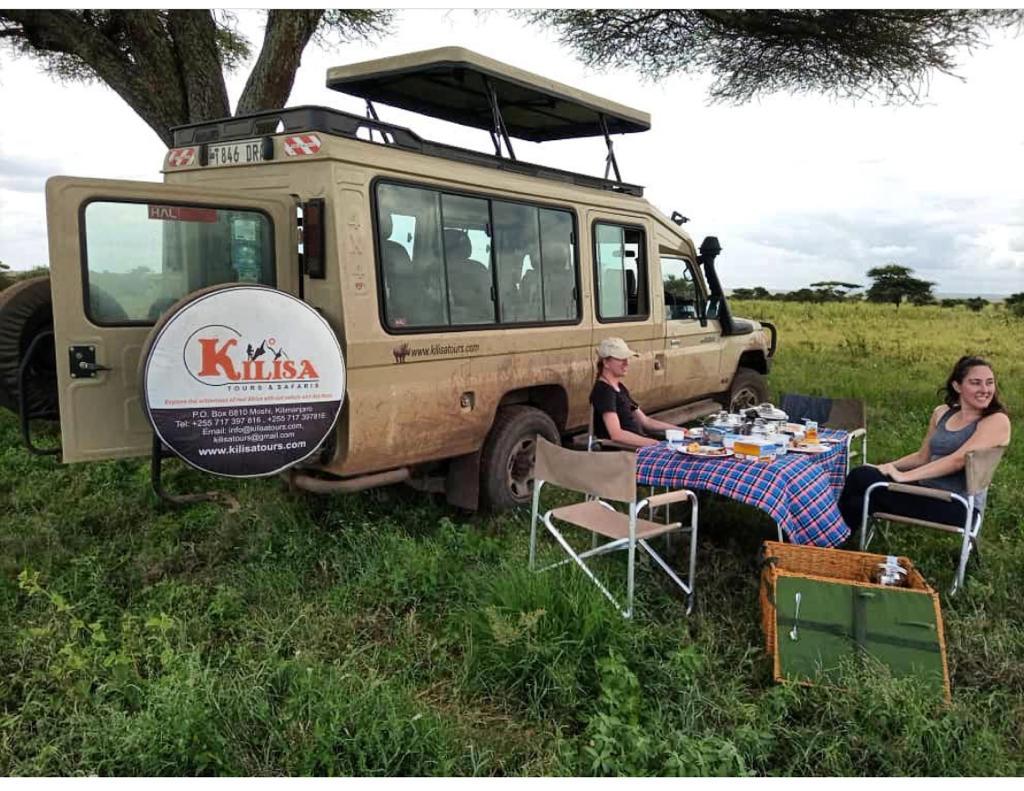
At Kilisa Tours, we offer all three approaches across our full range of safari packages. Here is a selection to help you find the right starting point for your trip.
Luxury Safaris — Northern Circuit
These packages are designed primarily for overland travel within the northern circuit, with fly-in upgrades available on request for any sector. All include a private vehicle, private guide, premium accommodation, and full inclusions.
- 4-Day Luxury Safari — Serengeti and Ngorongoro
- 5-Day Luxury Safari — Serengeti, Ngorongoro, and Tarangire
- 6-Day Luxury Safari — Full Northern Circuit
- 7-Day Luxury Safari — Lake Natron, Serengeti, Ngorongoro, and Tarangire
Migration Safaris — Fly-In Recommended
These itineraries are specifically designed to position you in the northern Serengeti for the Mara River crossings — and internal flights are the key to making this work within a standard safari timeframe.
- 7-Day Wildebeest Mara River Crossing Safari
- 6-Day Northern Serengeti Migration Safari
- 5-Day Tanzania Migration Safari
Mid-Range Safaris — Primarily Drive-In
Our mid-range safari packages are built around private overland travel, covering the northern circuit at an excellent value-to-quality ratio.
- 4-Day Mid-Range Safari — Tarangire, Serengeti, and Ngorongoro
- 5-Day Mid-Range Safari — Tarangire, Serengeti, and Ngorongoro
- 6-Day Mid-Range Safari — Full Northern Circuit
- 7-Day Mid-Range Safari — Lake Natron Included
Budget Camping Safaris — Overland
All our budget camping safaris operate by road. They deliver outstanding wildlife experiences at an accessible price point, with the same expert guiding and private vehicle standards as our premium packages.
- 3-Day Budget Camping Safari — Serengeti
- 4-Day Budget Camping Safari — Tarangire, Serengeti, and Ngorongoro
- 5-Day Budget Camping Safari — Tarangire, Serengeti, and Ngorongoro
- 7-Day Budget Camping Safari — Lake Natron, Serengeti, Ngorongoro, and Tarangire
Kilimanjaro and Safari Combinations
For guests combining a Kilimanjaro climb with a safari, internal flights between the mountain and the game parks are strongly recommended — both for time efficiency and for preserving your energy after the physical demands of the summit.
Practical Information for Fly-In Safaris in Tanzania
If you are leaning toward including flights in your itinerary, here is what to know in practical terms before you commit.
Which Airlines Operate Internal Flights?
Several reputable carriers operate scheduled and charter light aircraft services between Tanzania’s park airstrips, including Coastal Aviation, Air Excel, Auric Air, and Regional Air. Kilisa Tours handles all internal flight bookings as part of your itinerary — you do not need to research, book, or manage these independently.
What Are the Main Park Airstrips?
The northern circuit is well-served by airstrips at Lake Manyara, the Serengeti (multiple strips across the park including Seronera in the centre, Kogatende in the north, and Lobo), Ngorongoro, and Tarangire. For southern Tanzania, Ruaha, Selous, and Katavi all have functioning airstrips serving regular charter traffic.
How Far in Advance Should Flights Be Booked?
During peak season — particularly July through October — flight seats on popular sectors fill up quickly. We therefore recommend confirming your safari itinerary and internal flights at least four to six months in advance if you are travelling in this window. Contact our team early and we will secure availability before it disappears.
What About Luggage?
As noted above, light aircraft carry a maximum of 15 kilograms of luggage per person in a soft-sided bag. This is enough for a week-long safari if you pack sensibly. Our detailed packing guide, safari equipment guide, and complete safari checklist are specifically written with light aircraft weight limits in mind.
Is Travel Insurance Required?
Comprehensive travel insurance is essential for all Tanzania travel — and particularly important for fly-in itineraries, where flight delays or cancellations due to weather may affect your schedule. Ensure your policy covers trip disruption as well as the standard medical and evacuation provisions. Additionally, check our health and immunisation guide for pre-travel health preparation.
Which Option Is Right for You? A Quick Decision Guide
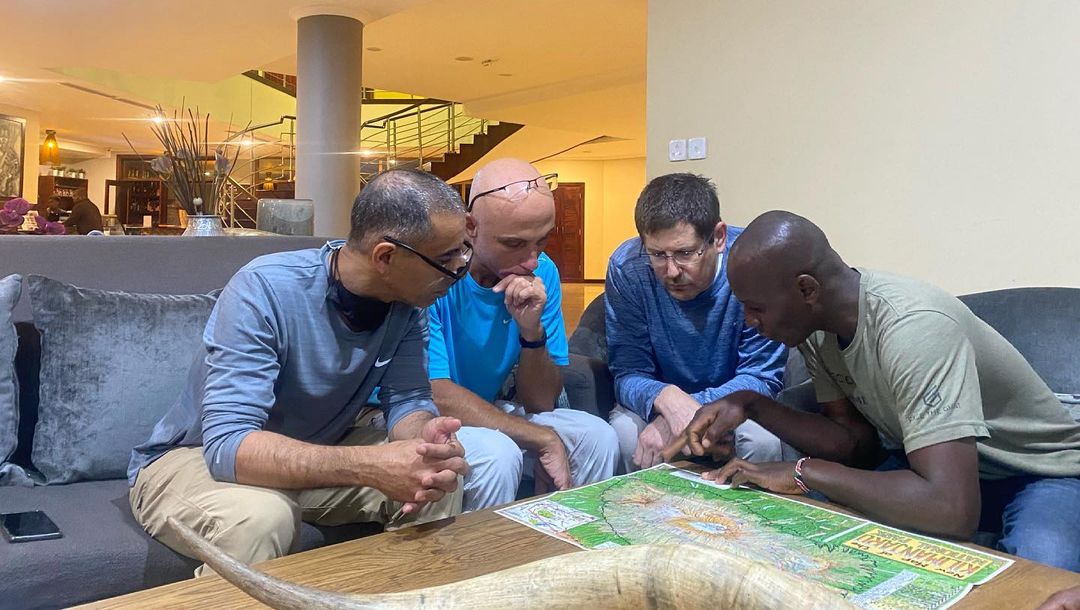
To summarise everything above into a clear, practical framework, here is our quick guide to choosing between fly-in, drive-in, and hybrid approaches.
| Your Situation | Our Recommendation |
|---|---|
| Four or five days covering multiple parks | Fly-in — road travel would consume too much game-viewing time |
| Seven or more days on the northern circuit | Drive-in or hybrid — the journey adds value over a longer trip |
| Want to see the Mara River crossings | Fly-in to the northern Serengeti — essential for positioning |
| Including Ruaha, Selous, Mahale, or Katavi | Fly-in — no practical road alternative |
| Budget-conscious traveller | Drive-in — invest savings in extra nights or better accommodation |
| Physical comfort is a priority | Fly-in or hybrid — minimise long road stretches |
| Cultural immersion matters to you | Drive-in — the road journey is irreplaceable for cultural context |
| Combining safari with Kilimanjaro | Fly-in for the safari portion — preserve energy after the summit |
| First-time Tanzania visitor, seven days | Hybrid — drive Arusha to Tarangire, fly to Serengeti, drive or fly to Ngorongoro |
Let Us Help You Decide
If you are still unsure which approach is right for your specific itinerary, dates, and travel style, that is precisely what we are here for. Our team has built hundreds of itineraries using both methods — and many more that combine the best of both. We will ask the right questions, understand your priorities, and recommend a routing that makes the most of your available time and budget.
Whether you ultimately choose to fly in low over the Serengeti at sunrise, arrive at the Ngorongoro rim by road through the highland mist, or do both on the same trip — Tanzania will deliver an experience that exceeds everything you imagined. Our job is simply to make sure every day of it is exactly where you want to be.
Browse our full range of Tanzania tours and safaris, explore our destinations guide, or check our safari FAQ for more answers. And when you are ready to talk through your specific plans, we are always available.
Contact Kilisa Tours today and let’s design your perfect Tanzania safari — by air, by road, or both.